
Character & Community

Like any college town, my hometown of Davis, California, has its share of characters.
The term — “characters” — typically comes across as pejorative, suggesting quirk, or worse. But I’d rather that my town include some citizens who are colorful and noteworthy — especially if they’re also kind, and community-minded.
We have a sub-genre of character in Davis, owing to our history as an originally bike-friendly town: the bike characters, the people you see often around town, on the bike paths, always on a bicycle, and rarely a typical one: They’re pedaling something noteworthy.
Aaron is a friend, and is one such bike-culture character. He calls himself the Bike Doctor, riding around Davis on one of his cargo bikes — or trikes — offering mobile bike repair. Last year Aaron purchased dozens of bicycles from the estate of a recently-deceased Sacramento man: the entire lot, no questions asked, many repairs to be made. (If you’re near Davis and in the market for a used but ready-to-pedal bike, reach out to Aaron via Instagram.)
Aaron believes in building community through cycling. He happens to be strong as hell on the bike, always at the front of our local “race rides,” even though his rig is at least 20 years older than the ones we MAMILs ride; on those rides he cultivates community by putting us all to shame, and providing a topic for coffee conversation.
Recently Aaron took an explicit step towards building community through riding: He organized last Sunday’s Yolo 100 Gravel Century: up to four laps around Davis’ 25-mile network of graveled levees, which protect the town’s thousands of acres of farmland from a rising Putah Creek, and from the floodplain of the Yolo Basin.
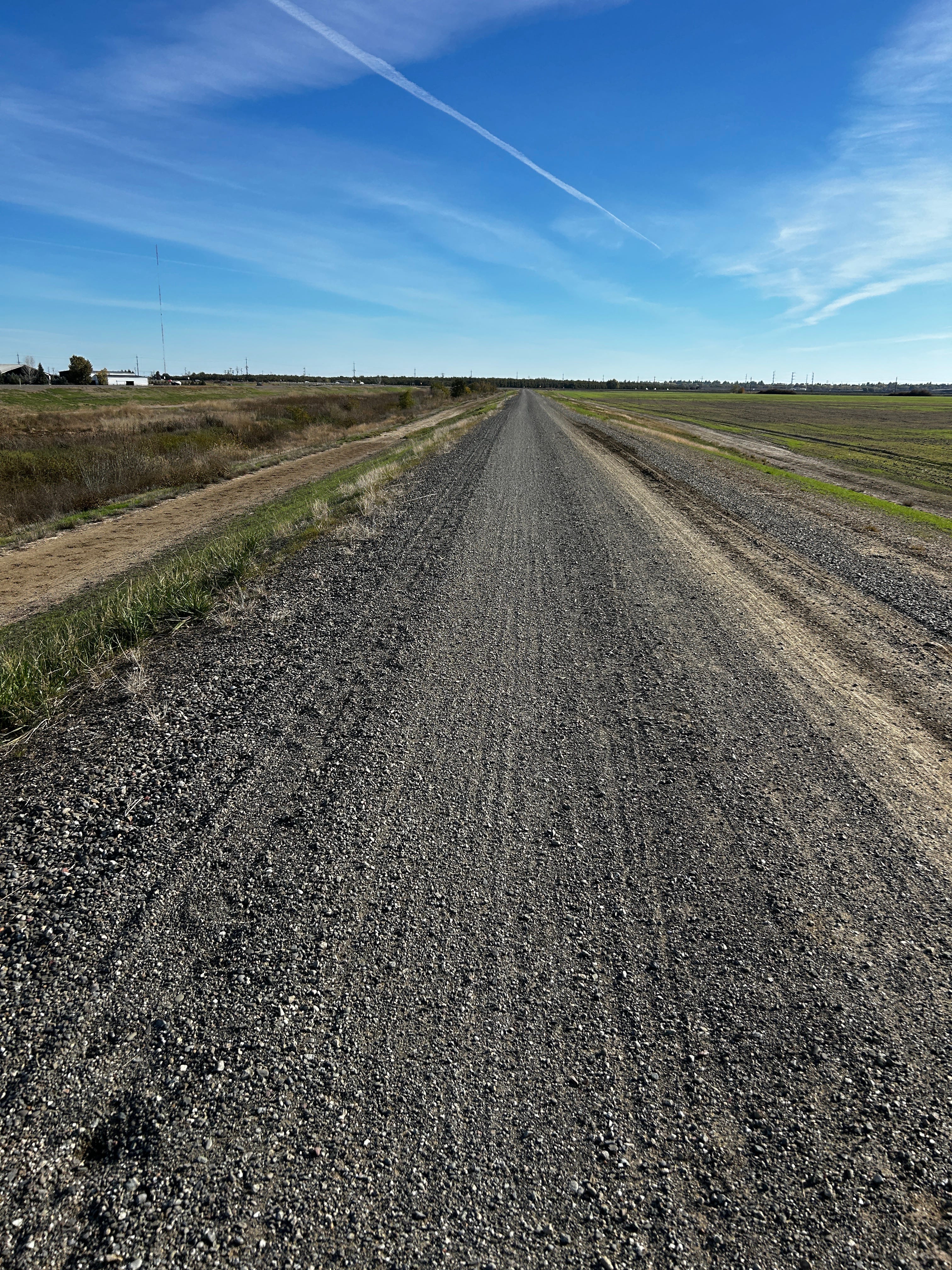
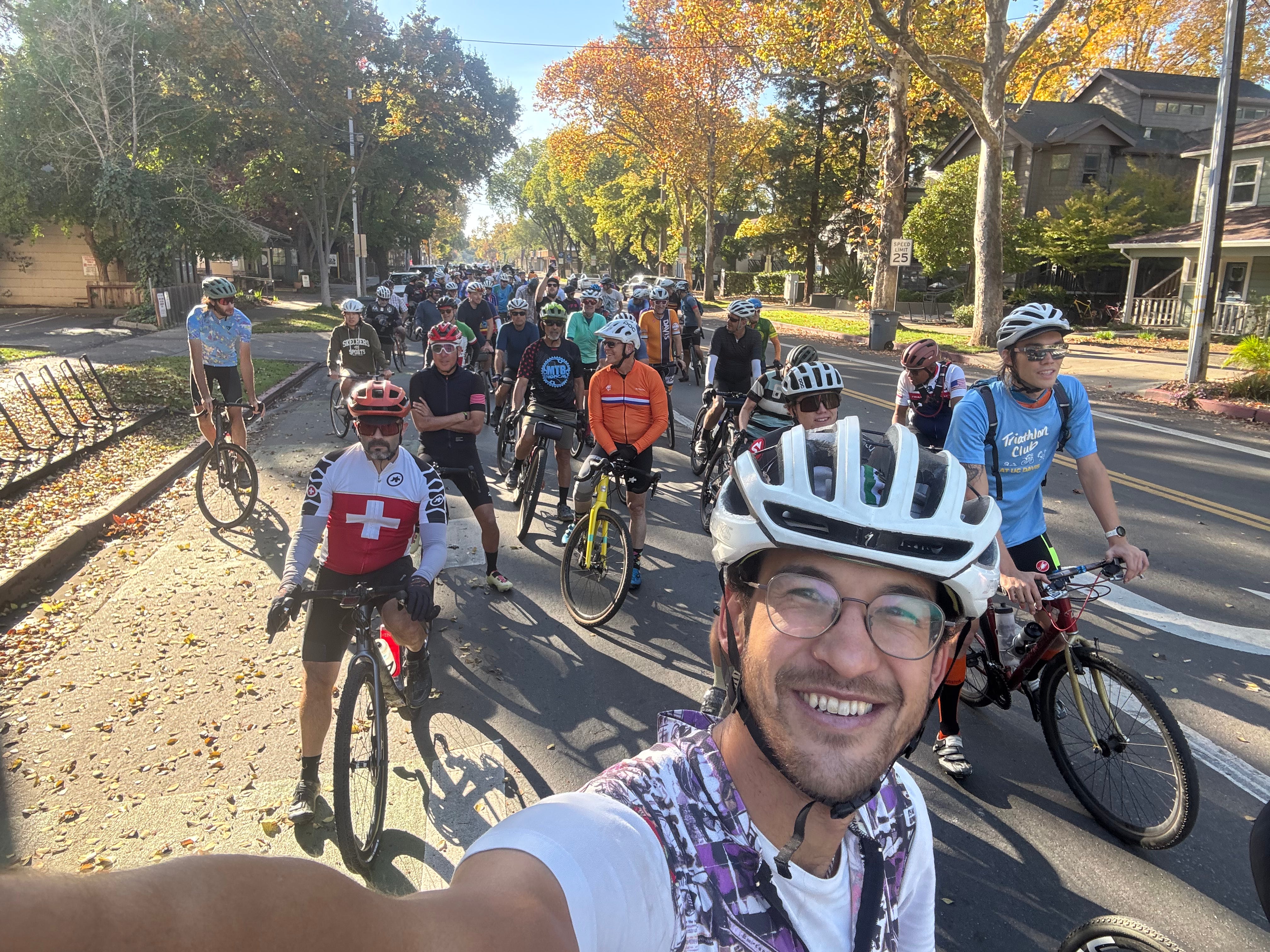
Always an easy mark for an organized ride — especially one that might turn into a race — I committed my Sunday to the full 100; Karen said she was up for a couple of laps herself, so we rode over to Davis’ Central Park at 9:00, thinking we’d be joined by 20, maybe 30 others.
By my count, it was more like 100! Chalk it up to savvy social media promotion by someone much younger than me — or to Aaron’s infectious enthusiasm — but the crowd was much larger than I expected.
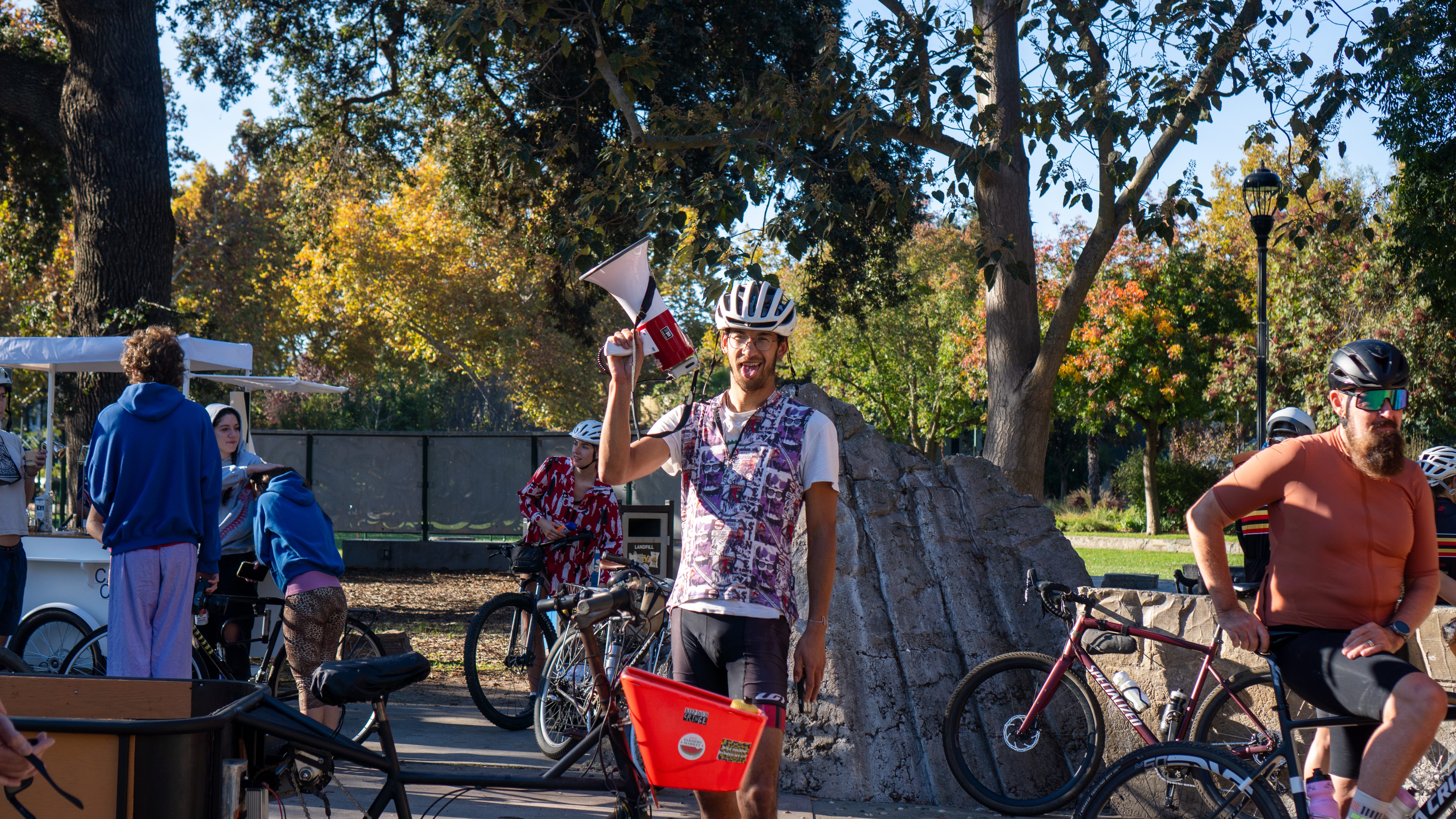
Maybe the draw was the emphatically low-key vibe: We signed no waivers; we received no route maps. We paid no registration fees. Aaron’s only shibboleth of officialdom was a megaphone, through which he described the route; when someone asked whether there were course markings, Aaron said that yes, he would get out and chalk the route — only we were about to start, and Aaron was there with us, and…the worst that was going to happen was we would take a shortcut, or maybe a slightly longer route. No timing chips; no number-bibs; no feed stations. It was all entirely refreshing.
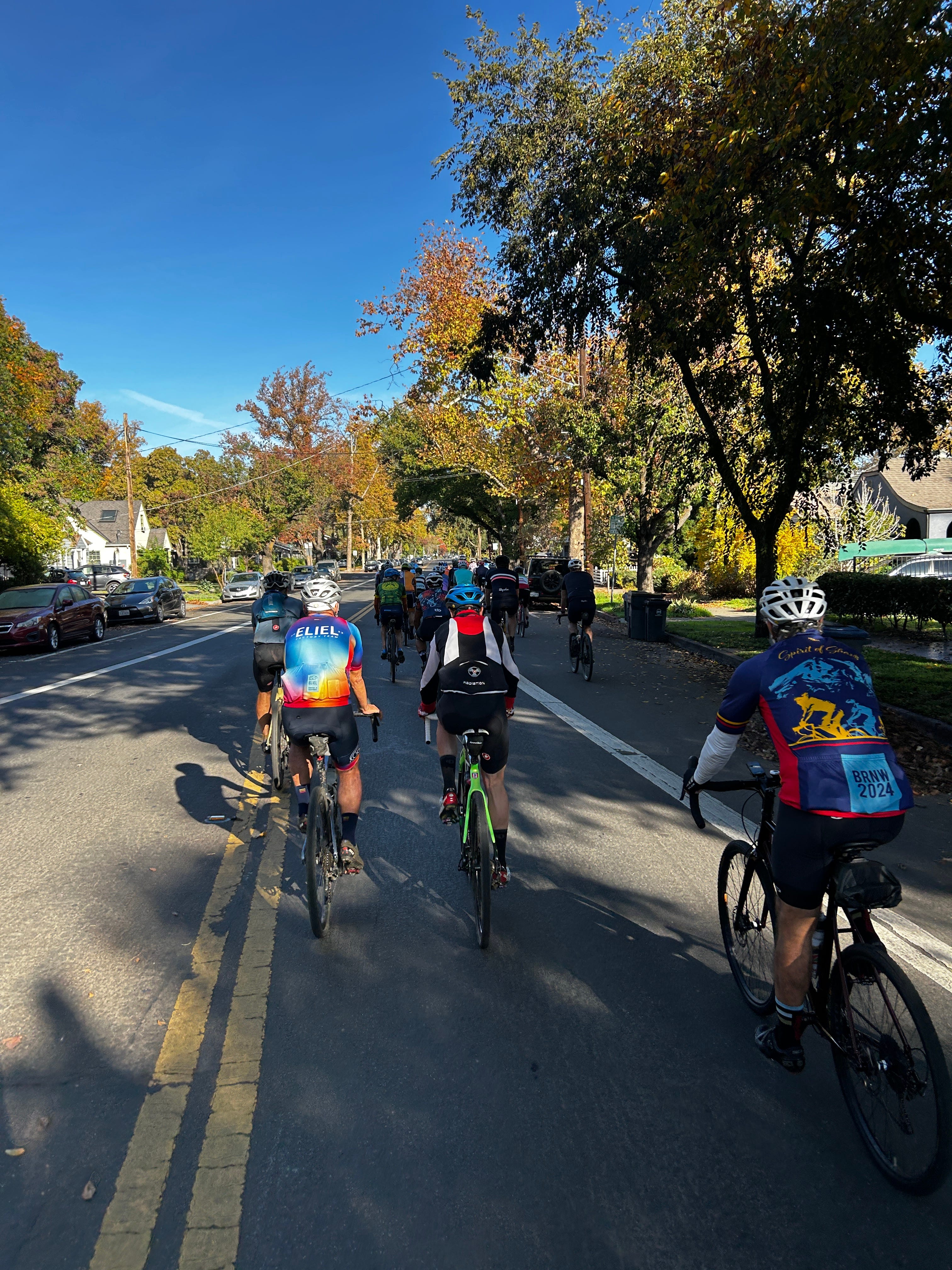
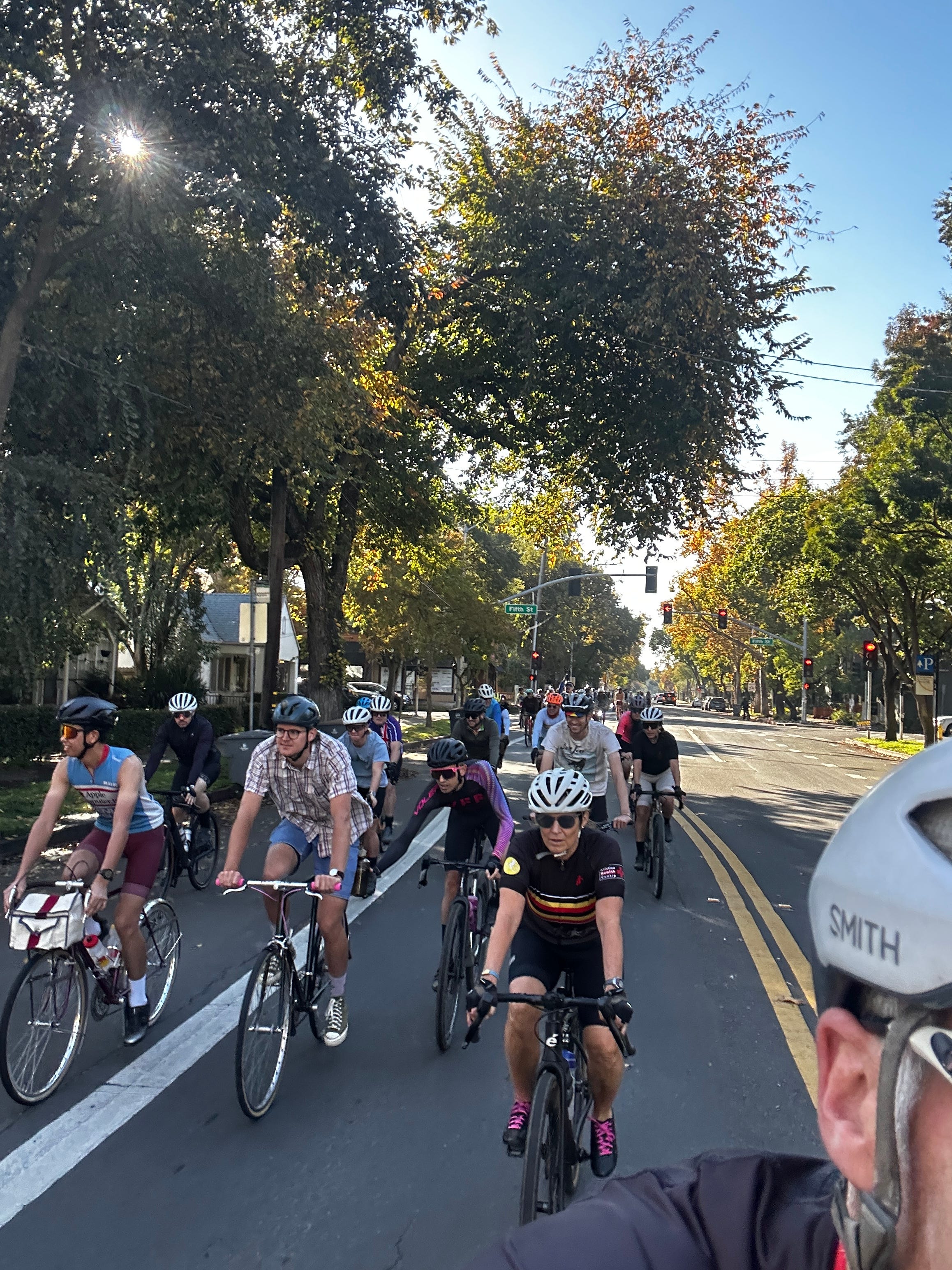
Still, our MAMIL group rarely fails to rise even to a faux-racing occasion, and the moment our peloton of riders aboard gravel bikes, mountain bikes, around-town rigs and even a few fixies turned from a paved street onto a gravel levee road, the pace was ON. I haven’t done a ton of gravel racing, but I know that part of the appeal is that drafting is of secondary concern: more efficient than tucking behind another rider is finding the smoothest line. And when there’s a crosswind of any effect (which there typically is around here), you’re left with a decision: forge my own line at the front, or try to find a lee that may put me in chunkier terrain.
Immediately ten of us were off the front, likely the only ones who cared in the least about our pace. After a brief reprieve on a paved road, different MAMILs took turns at the front, seeking to exert some hurt. A couple of unfamiliar face faded behind us; then a more familiar one, a friend from our local race rides, did as well. Soon we were five, and the pace was blistering.
We turned off of the levee road onto the street that would return us to Aaron’s start/finish spot. I was utterly blown. And I was 21 miles into a 100 mile ride.
So after waving to the folks hanging in Central Park, including the coffee cart guy and the kind man watching the stuff I’d left there, we did what any self-respecting, self-flagellating, self-aggrandizing would-be racers would do: We hurled ourselves into the punishing pace again. Turns at the front, surges, attacks, pretending to be Mathieu van der Poel in Paris-Roubaix: it was painful, and it was a blast.
We lost one of our five after two laps — 50 miles on the nose — and another after two-and-a-half. Three of us completed the third lap, half-heartedly, but for a few punches in the deepest gravel; when my two remaining friends told me they were finished for the day, that I would ride the final 25 miles on my own, I was sorry to see them go — but greatly relieved that I would ride my own unprovoked, mellow pace.
The temperature last Sunday was ideal for riding, maybe low 70s at the warmest. The sun was never high, this being November, and California’s four-season farming served up acres upon acres of deep-green crops. I pedaled the last lap easy, stopping to take photos, and passing a few comrades on their third laps.
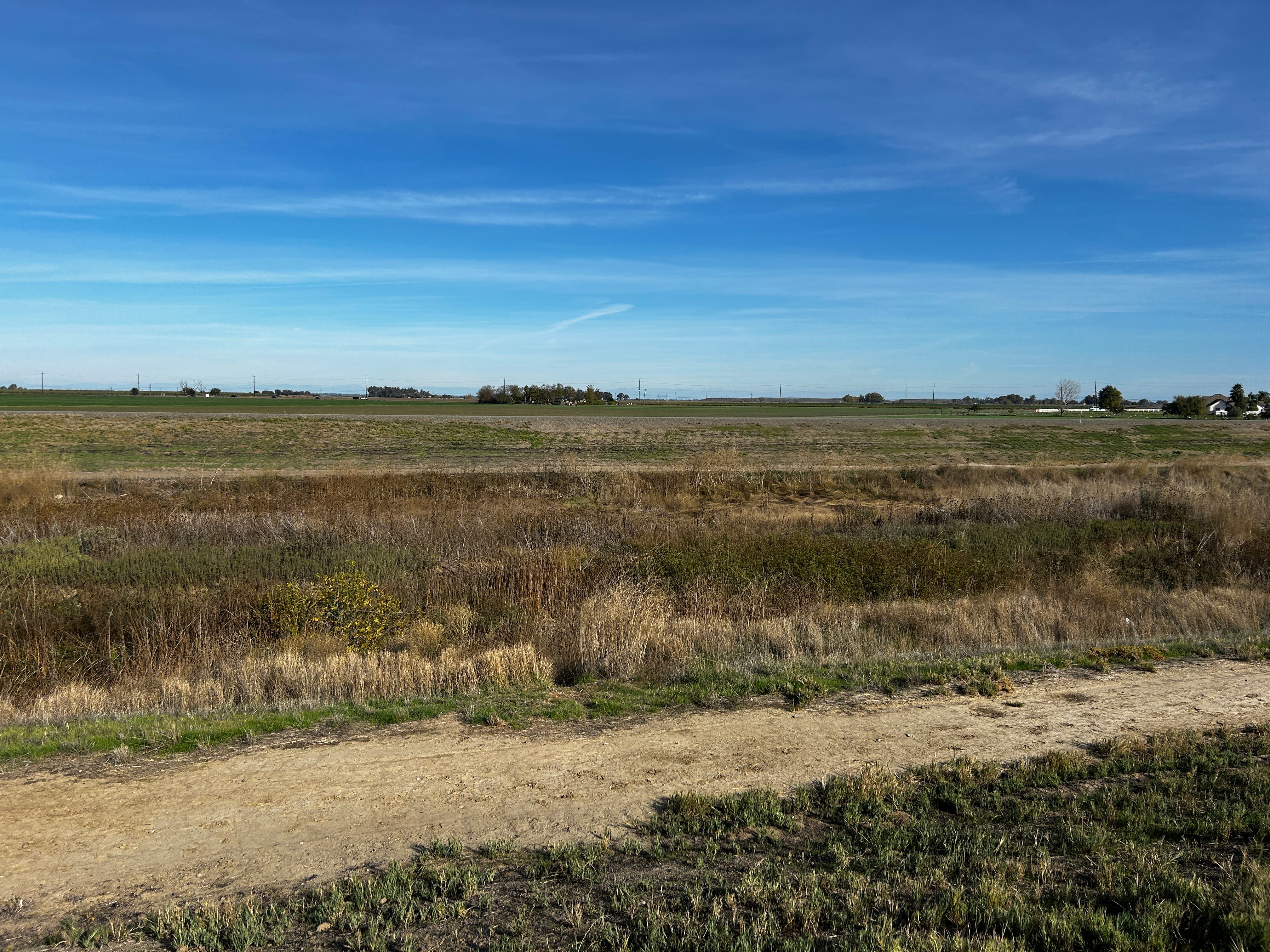
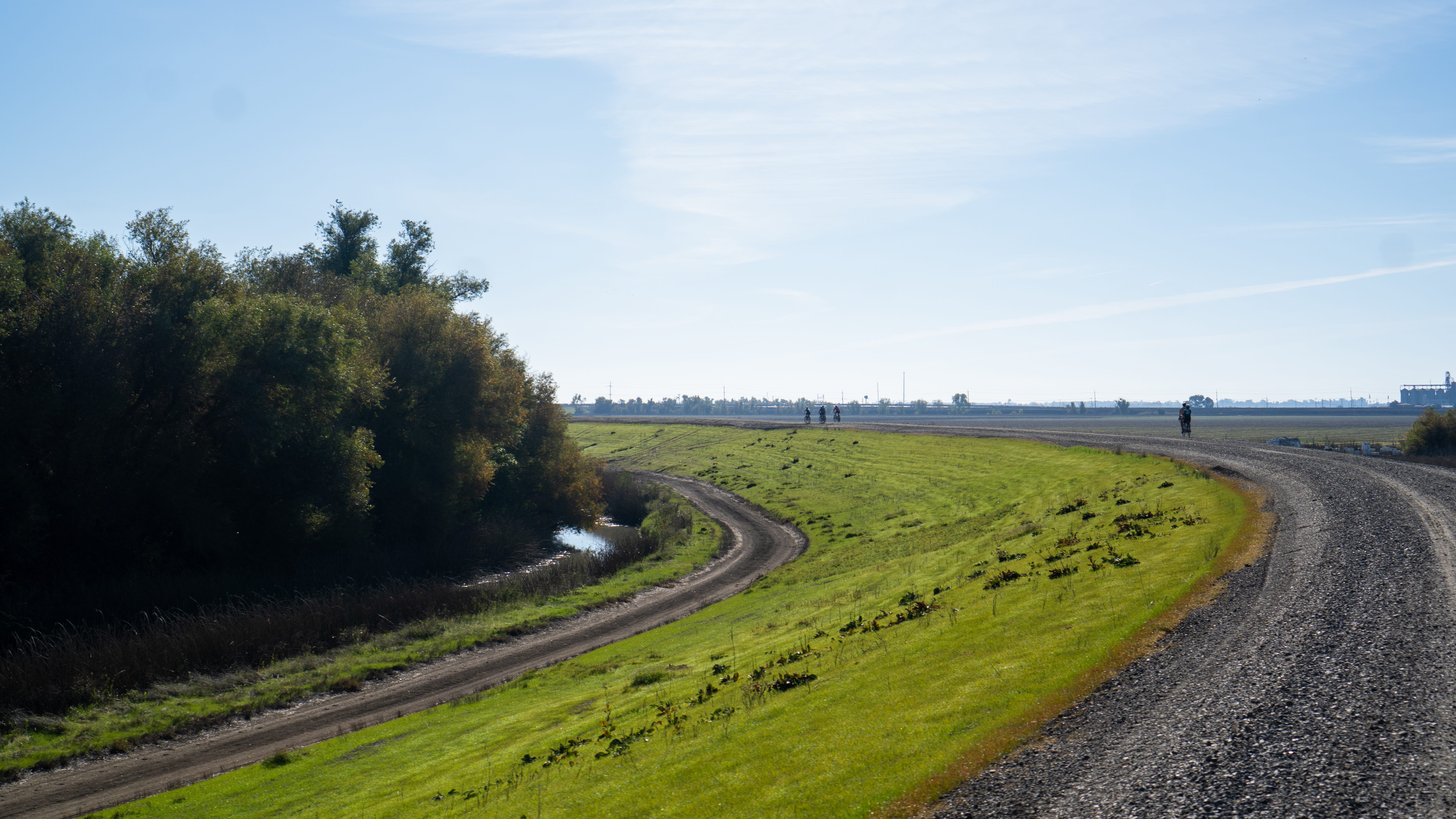
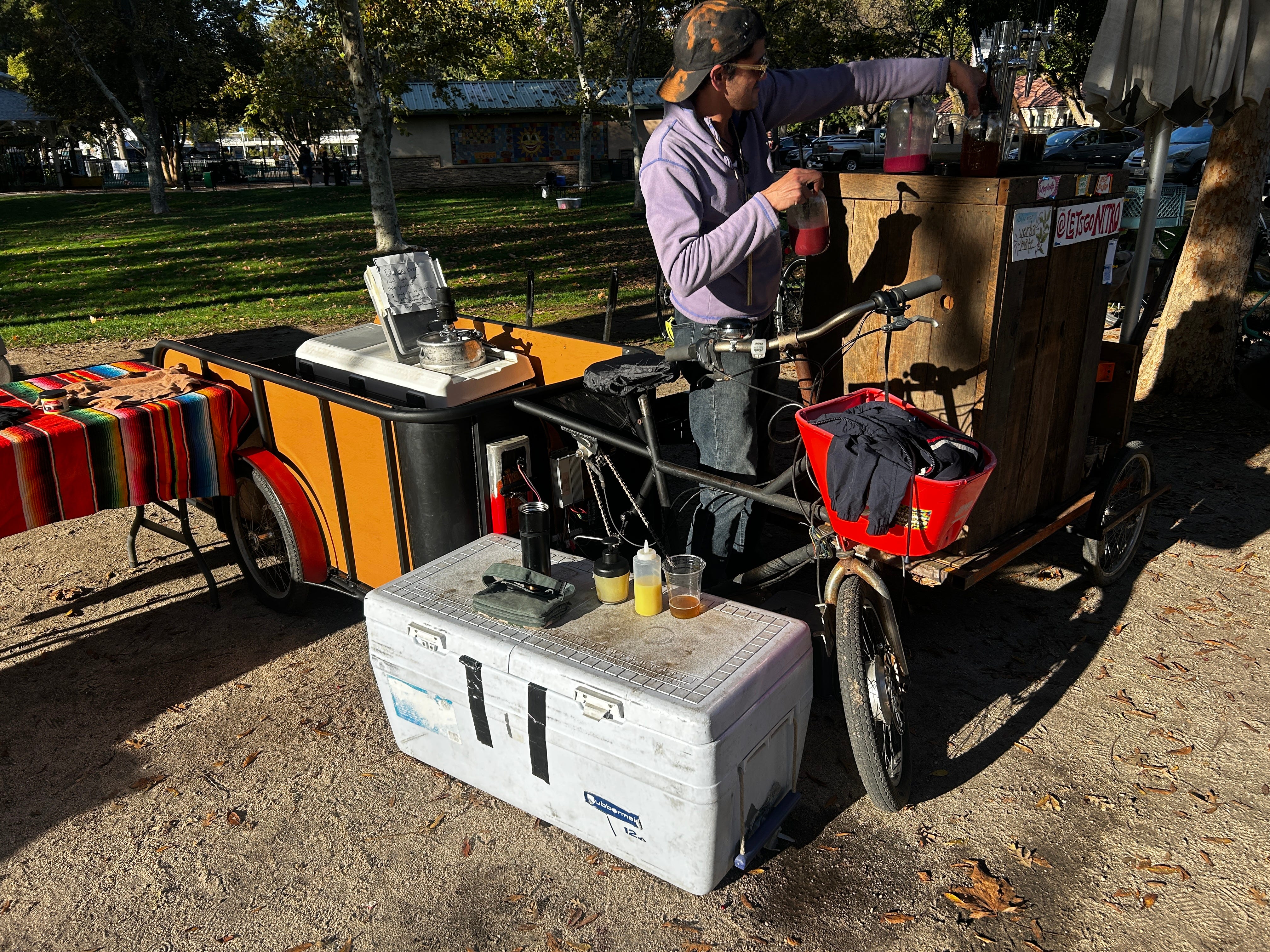
When I finished my fourth lap, the full 100, no one cheered me in; no one even knew I was finishing the Yolo 100. I purchased yerba mate (my first-ever) from a guy with a tricycle-cart full of it; talked with a couple of other riders; and then waved to Aaron as he rode away with a few others, beginning his fourth lap.
Karen rode over from our house — she’d completed two laps, her first gravel ride — and together we talked with some of our fellow cyclists. Some had ridden a lap; others two or three. Most spoke of sore rear-ends, thanks to the washboard terrain along the back third of the route, but also of the beauty of riding around one’s own hometown — and of discovering that 100 other people also wanted to spend a day riding bikes, maybe chatting or maybe hammering, either taking in the wide farmland views or breathing in the stirred-up dust of a fellow race-rider — or both, in my fortunate case.
So: chapeau to Aaron for organizing the Yolo 100. It wasn’t a fundraiser, or a money-maker, or sanctioned in any way. It was just a rolling community — albeit in a few cases, a rather aggressively pursued one.